
— Start of the story
A few months ago, a client asked us a simple question: “We plugged in a powerful AI model, so why does it still behave unpredictably in production?”
It's a question we hear more often than you'd think. And at SAARZ Int., working across AI solutions, automation, and cloud infrastructure, it's pushed us to think hard about a discipline that doesn't get nearly enough credit: harness engineering.
— The numbers tell the story
This isn't just a theory we've picked up. The data backs it up, and honestly, it's a bit sobering. Industry research circulating this year puts the figure at roughly 88% of AI agent pilots that never make it into production, a number that has now shown up across several independent studies, from Deloitte to S&P Global Market Intelligence. Gartner, meanwhile, expects more than 40% of agentic AI projects to be cancelled by 2027 if issues around governance and oversight aren't addressed.
Here's the part that stood out to us most: research from Forrester found that when these projects do fail, the reasons rarely trace back to the model itself. Around 41% of failures come down to unclear success criteria, and another 33% come down to agents not having the right access to tools or data, classic harness problems, not model problems.
The flip side is encouraging too. Agents that do make it to production are reportedly delivering strong returns, with some industry estimates putting average ROI above 170%. The upside is real. It's the journey to get there that trips most projects up, and that's exactly the gap harness engineering is meant to close.
— So what is it, really?
Think of a smart, capable new hire on their first day. They're talented, but they don't yet know your company's rules, your tools, who to check with before making a big call, or how to tell if their own work is actually correct. Left alone, even a brilliant person will make mistakes, not because they lack ability, but because they lack structure around them.
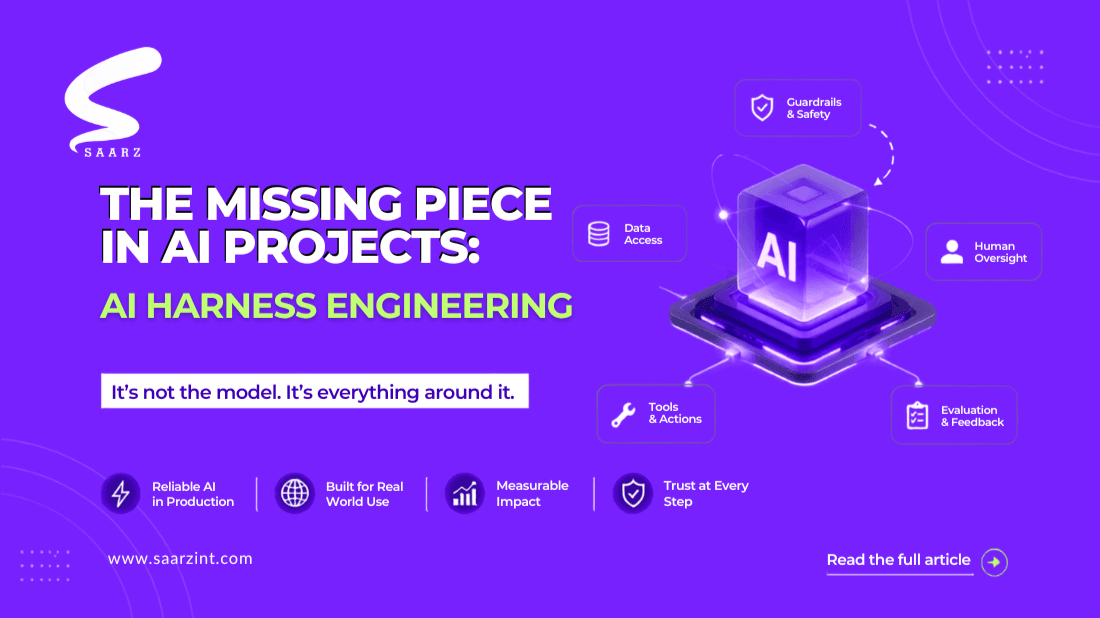
That structure is the harness. It's everything around the AI model, not the model itself, that decides what it's allowed to see, which tools it can touch, when it needs a human's sign-off, and how anyone checks whether its output was actually right.
— Why this matters more than the model choice
Here's the shift we've seen this year: the model itself is becoming less of a differentiator. Most strong models can reason well. What separates a reliable AI product from a flaky demo is the system built around it, the guardrails, the checks, the memory, the permissions.
At SAARZ Int., every AI feature we ship goes through this thinking. Before we ask “which model should we use,” we ask:
• What is this system allowed to do on its own, and where does it need a human to say “go ahead”?
• How do we know when it's wrong, before the customer finds out?
• If it fails, does it fail safely, or does it just keep going?
• Can we trace back why it made a particular decision?
None of these questions are answered by a bigger or smarter model. They're answered by good engineering around it.
— A quick example
Say you're building an AI assistant that can update customer records. Without a harness, it might update the wrong field, or worse, delete something it shouldn't. With a harness in place, it works inside clear boundaries: it can propose the update, but a validation check confirms the format is right, and anything touching sensitive data pauses for a human glance before it's final. The model didn't get smarter. The system around it got safer.
— Where we see this going
We don't think harness engineering is a passing trend. As AI systems take on more autonomous tasks, from customer support to internal automation to writing code, the businesses that get real, dependable value out of them will be the ones who invested in this invisible layer of structure, not just the flashiest model.
It's a bit like plumbing. Nobody talks about it at dinner parties, but it's the reason everything else works.
That's the lens we bring to every AI project at SAARZ Int.: build the intelligence, but never skip building the structure that keeps it trustworthy.